
Why Limiting Beliefs Live in Your Body, Not Just Your Mind
You've done the inner work. You've journaled, prayed, read the books, and renamed the lies. So why does your body keep running the old program?
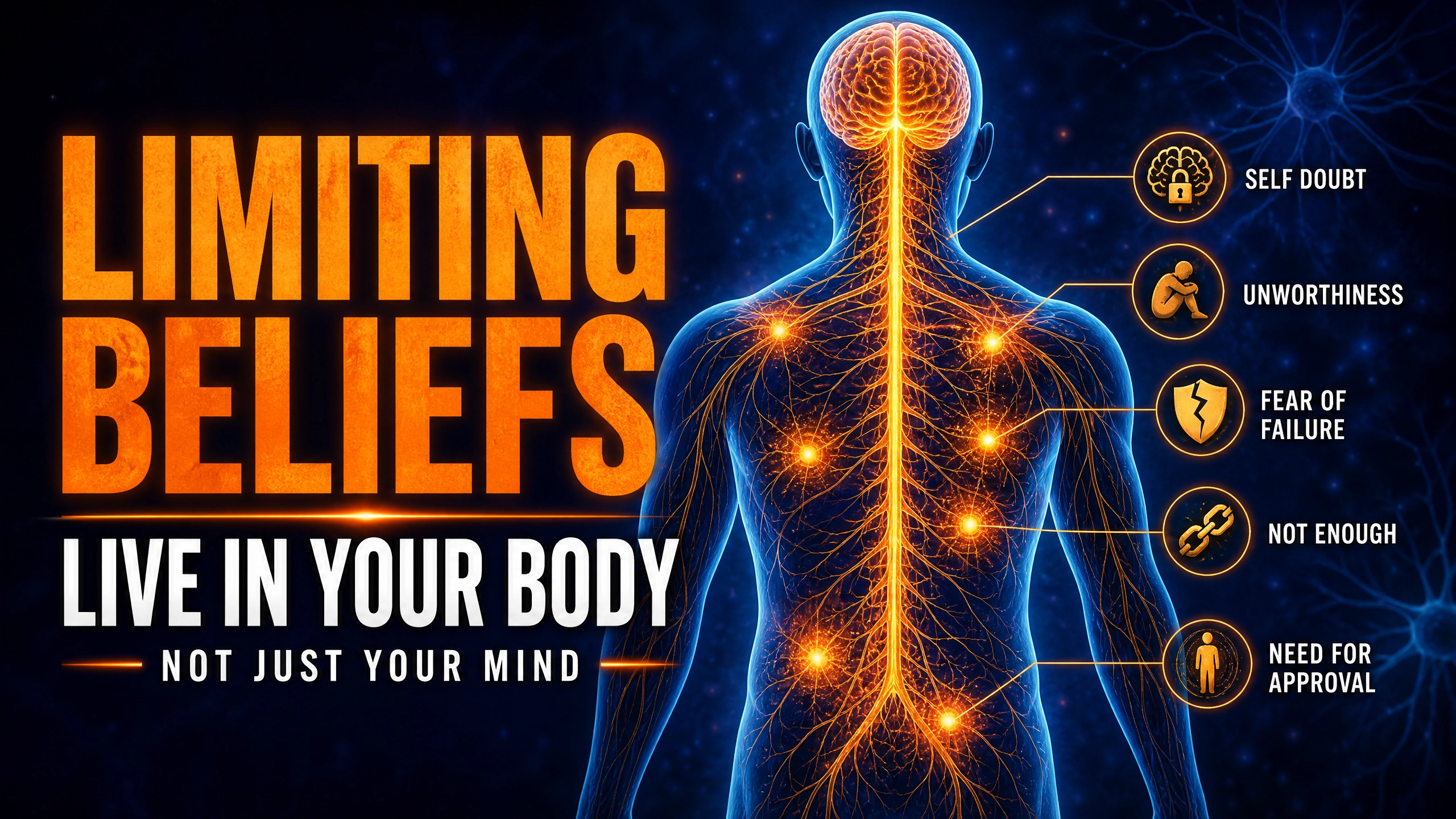
Most approaches to limiting beliefs start in the mind — and that is exactly why they only get you partway.
You identify the belief. You trace it back to its origin. You declare it no longer true. You replace it with an affirmation. You pray over it. And for a moment, something shifts. But then — often quietly, sometimes dramatically — the old pattern reasserts itself. The self-sabotage returns. The body keeps doing what the mind said it wouldn't anymore.
This is not a failure of faith. It is not a lack of willpower or discipline. It is not evidence that you are too broken to change.
It is neuroscience. And once you understand it, everything changes.
Watch: Rewiring the Body — Applied Neurology for Lifelong Healing · Dr. Talks
There Are Two Kinds of Belief — And Only One Lives in Your Head
Cognitive neuroscience distinguishes between explicit beliefs and implicit beliefs. This distinction is everything when it comes to healing.
Explicit beliefs are the ones you can articulate. They live in the prefrontal cortex — the rational, language-processing part of the brain. "I am worthy of love." "God is for me, not against me." These are the beliefs you work with in cognitive therapy, journaling, and declarations.
Implicit beliefs are different. They are not stored in language. They are stored in the body — in the nervous system's tissue memory, in your autonomic responses, in the way your chest tightens when someone raises their voice, in the way your breath shallows before you ask for help, in the way your body braces before you enter a room where you might be evaluated.
Your nervous system learned these patterns long before you had words for them. And it has been rehearsing them ever since — without asking permission from your rational mind.
For as he thinks in his heart, so is he.
— Proverbs 23:7a (NKJV)What Neuroplasticity Actually Means for Your Belief System
Neuroplasticity — the brain's capacity to form new neural pathways — is real and well-documented. But it is often misapplied as a purely cognitive concept: think new thoughts, form new grooves. And while that is true as far as it goes, it misses the deeper layer.
Your implicit beliefs — the somatic ones — are not changed by thinking differently. They are changed by experiencing differently. Specifically, by giving the nervous system repeated new inputs that don't match the old prediction — and helping it survive that mismatch without going back into threat response.
The nervous system is a prediction machine. It is constantly anticipating what comes next based on what has happened before. When a new experience violates that prediction in a way the system can tolerate, it updates its map. That update — when it happens consistently over time — is what we call rewiring.
This is why applied neurology is not optional in belief work. The drills are not supplementary. They are the mechanism by which the body — not just the mind — learns the new story.
What Somatic Beliefs Look Like in Real Life
Let me give you some of the patterns I see most often in the women I work with — because you may recognize yourself here.
"The only time I can rest is when I'm sick."
This belief is not usually conscious. But the body has learned the equation: illness = permission to stop. So unconsciously, the nervous system keeps choosing illness as the only available exit from an impossible pace. The cognitive mind may declare "I am allowed to rest" — but until the body has experienced rest as safe outside of sickness, the pattern persists.
"The only time anyone pays attention to me is when I am in crisis."
When connection has been consistently paired with crisis, the nervous system learns to produce crisis as a bid for connection. Not consciously. Not manipulatively. Simply because that is the data it has. The body is not broken — it is running a very logical program based on everything it has been taught.
"I have to earn my healing."
This one shows up in the woman who follows every protocol perfectly and still cannot receive. Cannot let good in. Cannot trust that progress is real. Because deep in the nervous system is a belief that her healing is conditional — that she will lose it if she lets her guard down.
How We Actually Rewire a Somatic Belief
The approach I use with clients is not suppression. It is not "that belief no longer serves you, so we're releasing it." That framing dismisses something that has been doing a real job for a long time — and the nervous system does not respond well to being dismissed.
Instead, we get curious. We ask:
- When did this belief arrive? What was it protecting you from?
- Did it actually help? How?
- Is it still doing that job, or is it now doing something else?
- What would happen if this belief were no longer the primary story?
And critically — we do this work while simultaneously running an applied neurology drill. Not after. Not before. During.
Because here is what happens when you begin to question a deeply held somatic belief: the nervous system activates. It reads the challenge as a threat to its prediction model — and it will mobilize to protect that model. The neurology drill keeps the window open. It provides enough parasympathetic input to hold the nervous system in a state where it can tolerate the dissonance — where it can process the new information without slamming the door.
What You Focus On, Your Nervous System Rehearses
There is a clinical reality behind the principle that what you focus on expands — and it runs deeper than mindset.
Every time you narrate a belief — about your diagnosis, your limitations, your worthiness, your future — your nervous system records it. The language you use about your health is not just words. It is input. And the nervous system interprets input as instructions.
This is why I am careful with how clients track their symptoms. Tracking can easily become identity rehearsal. "I have Hashimoto's." "I have chronic fatigue." "I can't handle stress." Every repetition deepens the groove — not because you are creating your illness with your thoughts, but because the nervous system is genuinely calibrating its outputs around the patterns it is given most often.
And do not be conformed to this world, but be transformed by the renewing of your mind, that you may prove what is that good and acceptable and perfect will of God.
— Romans 12:2 (NKJV)You Are Not Fighting Your Beliefs. You Are Teaching Your Body a New Truth.
The beliefs that have kept you stuck are not your enemies. They are old allies that outlived their usefulness — running a protection protocol that no longer matches your current reality.
You don't have to fight them into submission. You have to give your nervous system enough new, repeated experiences of safety that it begins to loosen its grip on the old prediction.
That is what applied neurology makes possible. Not by bypassing the body. Not by reasoning your way out of survival. But by speaking the nervous system's own language — sensation, movement, breath, regulation — and teaching it, one experience at a time, that there is a new story available.
Inside Rewire Lab, I walk you through the full process of somatic belief rewiring — combining applied neurology drills with deep identity and belief work rooted in neuroscience and Scripture.
Apply for Health Labs → RESET Workshop →Dr. Laurel Oliver is a board-certified Doctor of Functional Medicine, Applied Neurology Practitioner, Certified Biofeedback Clinician, Ordained Chaplain, and author of Ground Zero Healing and Rewire Revival. She is the founder of Rewire Revival — a faith-rooted, neuroscience-based healing ecosystem serving women and ministry leaders worldwide.